
Category Archives: Humanities and Social Sciences

What’s in an umlaut?

This post was contributed by Professor Penelope Gardner-Chloros, Department of Applied Linguistics and Communication

It sometimes seems as if the news is made up of either cataclysmically large or vanishingly small issues. There are quite enough of the former to worry about at the moment, you might think – and the latter – the ‘human interest’ stories – are just there to sell newspapers.

UmlautIn theory, they do not get much smaller than the argument, reported in this week’s papers, which is raging in a small town in Minnesota.

Lindström was founded by Swedish immigrants in the 19th century. The reason for the current battle is that the Minnesota Department of Transportation has decreed that the town name should consist only of ‘standard English characters’. Therefore the umlaut, i.e. the two dots above the o, has been omitted from the sign. The inhabitants are up in arms over this – apparently petty – issue.

It is interesting to look beyond the apparently trivial casus belli and consider the deeper issues at stake. Is it possible that someone in the Transportation Department is ‘anti-immigrant’, or at least very right wing (in European terms)?

They may be a supporter of the ‘English Only’ movement, which argues that immigrants should integrate linguistically. Rather than being encouraged to maintain their language of origin, which linguistic studies have shown time and time again to be beneficial to their OVERALL linguistic proficiency AND to their wellbeing, in some states they are instead obliged to take additional remedial English classes.

In this case, the immigrants in question have long ago been eaten by the worms; the umlaut-supporters are merely symbolically honouring their distant ancestors, and their own origins.

The kindest interpretation of the Department’s refusal to add the umlaut is that they just want an easy life and cannot be bothered with the idiosyncacies of the local population, which necessitate additional signwriting resources. But I suspect the issue is related to their convictions about what it means to be American.

Whichever it is, the importance of the umlaut for the population clearly goes well beyond its tiny presence on the town sign. Like so many linguistic issues, it can only be understood in terms of the link between language and identity. Crush my language, my accent, my alphabet, my name, and you deprive me of my individuality, my history, my sense of belonging to a particular group.

In Alsace under the German Occupation, Jean had to become Hans and François had to become Fritz – on pain of serious punishment. Europeans joining Islamic State change their names to Islamic ones. In this case, a Swedish name which indexes the heritage of the town is being bleached into an English name. Perhaps next year it could have an e added at the end, then why not remove the ‘str’ and replace it with an h? ‘Lindhome’ would sound as American as apple pie.

Of course none of this matters a single jot compared with the big issues in the news – until you start to realise that language is one of the main ways in which our identity is expressed. Languages, words, names – and people’s expressed wishes about them – should not, and cannot, be swept under the carpet – or painted out on signs.
Find out more about Professor Penelope Gardner-Chloros

Researching History of Art in Venice and Padua

This post was contributed by Dr Laura Jacobus, senior lecturer in the Department of History of Art.

Sitting at my desk squinting at indecipherable medieval documents, I’m suddenly transported to the near-future and the summer term at Birkbeck, when I’ll be sitting at my desk squinting over indecipherable exam scripts. Academics take research leave in order to refresh their thinking and inform their teaching, keeping up at the cutting-edge of knowledge, so that we can then deliver that to our students and to the wider world of scholarship. But from students’ point of view our disappearances may be less explicable. So I thought I’d write a bit about what I’m doing.

I’ve been using this term to pull together research that I began many years ago on the Arena Chapel in Padua. It’s a fourteenth-century building, with practically every surface decorated with stunning frescoes by Giotto. I have already published a book on it, but I’d found a great deal of material which was still of interest, and it didn’t belong in that book because it had nothing to do with Giotto. This term is an opportunity to pull that material out of the filing cabinet (yes, some of it goes back that many years) and try to make sense of it, getting an overview of what needs to be done and doing some of it.

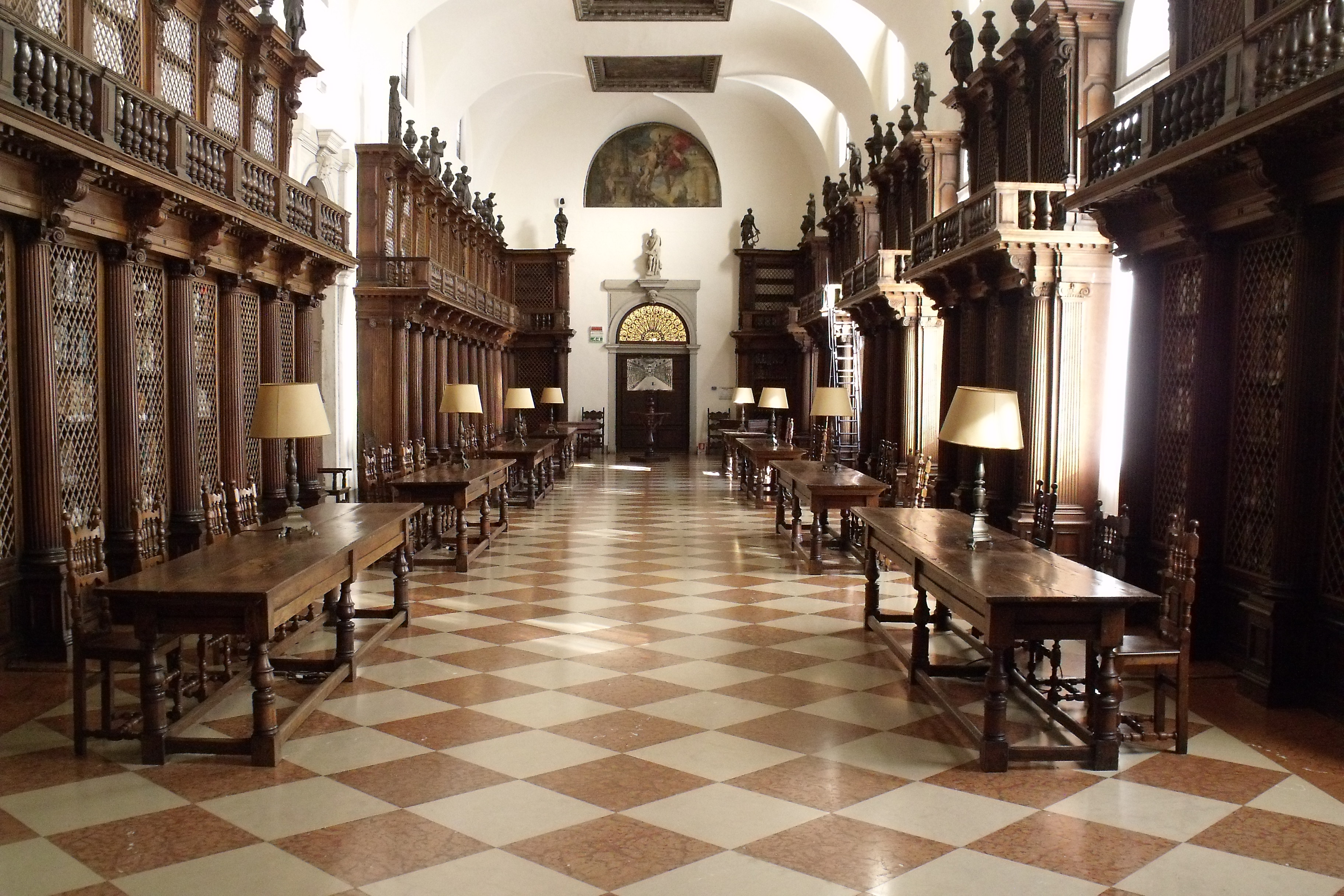
Before my leave started I’d booked a two-week research trip to Venice and Padua, and over Christmas I planned that meticulously. I had nine different archives and specialist libraries that I wanted to visit, some of them with quite short and irregular opening times. As things turned out I only managed seven of them, and in one of those the specialist collection I needed to see wasn’t available, but this is quite a high success rate for a research trip, and I may be able to go back for a few more days before the end of my leave. And, I have to say, some of those libraries were a pleasure! I’m including a photograph (below) of one, the seventeenth-century library of the monastery of San Giorgio Maggiore, designed by Longhena and still with all its original furnishings.  I was very lucky to be staying in a newly-opened research centre in the former monastery there, so this was my local library during my stay. Before anyone gets too envious, I should also say that one of the other libraries was in a below-sea-level 1960s basement. Still, there’s no denying that doing research on Italian medieval and renaissance art has its attractions.

Longhena Library

The seventeenth-century library of the monastery of San Giorgio Maggiore, designed by Longhena and still with all its original furnishings

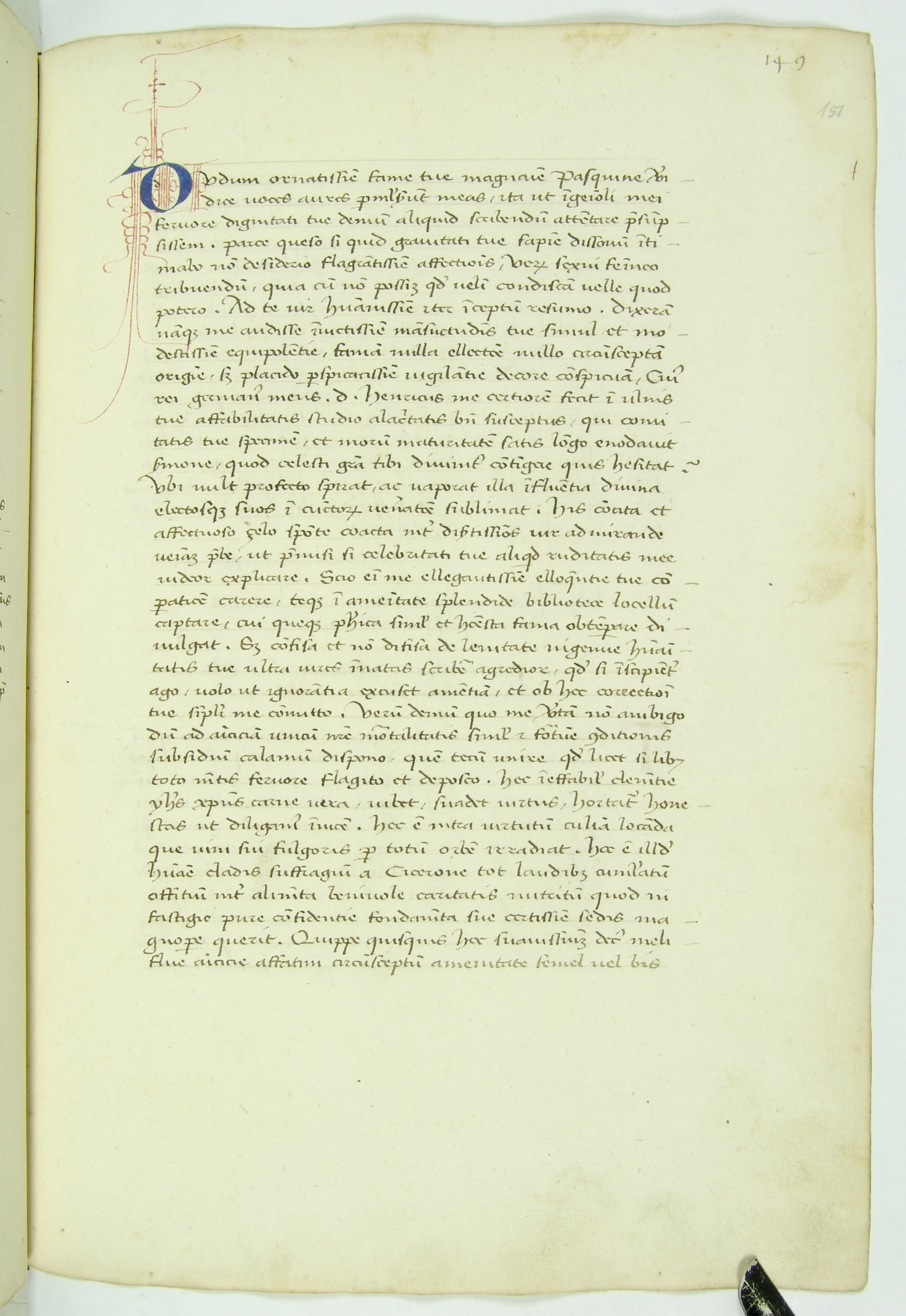
The trip to Italy allowed me to find and photograph around twenty documents that should help fill some of the gaps in my evidence, but first I have to read, transcribe, translate and edit them.  I returned to London three weeks ago, and have spent much of the time since then doing just that.  It will take many more weeks to do it (more weeks than I have leave), and I am including photographs of some of them so that you can see why. A few are rather beautiful – such as this copy of a letter from Maddalena Scrovegni, the first female humanist, to the Duke of Milan in 1389…

Maddalena Scrovegni's letterMaddalena Scrovegni letter detail

…but most are definitely not. This is the copy of her brother’s will, written at a time when the family had lost everything in 1435.

DSCF0993 Pietro endowment 1435 July 30 cropped p.1Pietro Scrovegni will (1444-1450 copy) detail

I’m interspersing the work on these transcriptions with drafting sections of the next book, treating one kind of work as a break from the other. It sounds like a messy process, and in many ways it is, but the shape of the book is gradually emerging from these parallel processes of thinking, writing and evidence-gathering. If you happen to be working on a dissertation or thesis, this may sound familiar- as will the feeling of time running out! One day, a book called ‘The Afterlife of the Arena Chapel’ will appear, but probably not before I’ve marked quite a few more medieval-looking exam scripts.

A reflection on the Research Excellence Framework 2014

TStephenFrosh_2014his post was contributed by Professor Stephen Frosh, Birkbeck’s Pro-Vice-Master for Research. In December 2014 the UK higher education funding bodies published the results of the Research Excellence Framework (REF), a peer review process which evaluates the quality of research in the UK’s universities.  Funding decisions based on the REF results will be announced this spring.

The results of the 2014 Research Excellence Framework (REF) were published in December 2014 and have been widely reported. While the official results of this six-yearly audit of university research take the form of institutional ‘profiles’ made up of outputs, impact, environment and an overarching narrative, there has also been strong  interest in where each institution sits in the various informal league tables that have followed.

Birkbeck did well in the REF. In keeping with the rest of the sector, our results improved significantly since the last such research assessment in 2008, when 56% of our research was rated as ‘world-leading’ or ‘internationally excellent’, the top two categories. This time, 73% of our research was judged in those categories. Unlike many universities, our performance was not inflated by a strategic decision to include only our most research-active academics in the assessment. Birkbeck submitted 83% of eligible staff to the 2014 REF, well above the national average. This led to the College’s strong performance in league tables which take into account the percentage of staff, rather than just the overall grade point average (GPA) of research, submitted. Birkbeck achieved a ranking of 30th in the UK for its research by the Times Higher Education – placing the College above Russell Group institutions such as Cardiff, Leeds, Liverpool, Queen Mary, Sheffield and York.

Of the 14 subject areas that Birkbeck submitted, half were rated in the top 20 nationally. Our science submissions performed exceptionally well, with Psychological Sciences rated 5th in the UK and the College’s two joint submissions with UCL – Earth Systems & Environmental Sciences, and Biological Sciences – rated 6th and 11th respectively.  Our outstanding subjects in the Times Higher Education’s ‘research-intensity’ league tables  include Law, ranked 6th overall (putting it among the top 10 law schools alongside the LSE, UCL, Oxford and Cambridge) and History, ranked 7th.

Similarly, the College performed strongly in league tables based on the percentage of research judged to be ‘world-leading’, indicating the very high quality of much of our research. I am also particularly pleased that – in addition to the outstanding performance of some of our top disciplines – we can celebrate the good performance in the REF of new areas such as Sociology and our reconfigured Modern Languages group, reflecting the College’s ability to build new research areas over time.

The 2014 REF threw up new challenges for the sector. For the first time, it required universities to demonstrate the impact of their research beyond academia. The College responded very well to this challenge, with good ratings in most areas and outstanding results in three subject areas – History; Art and Design; and Psychology, Psychiatry and Neuroscience – where 100% of Birkbeck’s submissions were rated in the top two categories for impact. The broad scope of our research and its impact are showcased on the College research webpages under six themes: arts, history and culture; conservation and heritage; learning, education and development; politics, society and the law; science and biomedicine; and work and the economy. This demonstrates how closely Birkbeck’s research relates to many aspects of our everyday lives – whether influencing policy-makers in their thinking about early years education; working with major companies to educate parents about their child’s development; or trialling new drugs for the treatment of cancer.

The results of the REF are important for many reasons, including the credibility of our claim to be research-intensive, our reputation with the public and our strong standing within specific disciplines. Importantly, from a financial perspective, the likelihood remains that HEFCE research funding will be allocated according to a formula based on proportion of 4* and 3* overall outcomes multiplied by number of staff submitted, with 4* more heavily weighted.  What this means for Birkbeck will be clearer when funding decisions based on the REF results are announced in spring 2015. At the moment, we expect to earn about the same amount College-wide (though with a somewhat different distribution between disciplines within the College) from the REF as we have done from the RAE (well over £6m in 2014-15) – but we shall have to see whether the funding formula changes, and also whether the UK’s spending on research and development as a proportion of GDP, which is very low by international standards, continues to fall. Birkbeck’s results also show the enormous amount of hard work that has gone on in recent years by our academics. At a time of turmoil in the higher education system, they have continued to produce top-quality research.

The REF was a stressful experience for many people in the College and I am especially grateful to them for the work they put into Birkbeck’s submission. As might be imagined, we have been poring over the results and thinking about how to build on them for the future. We have a new Research Strategy that aims at facilitating the creativity of our research community. We are looking closely at issues of research leadership and we are reviewing the policies and provision we have in relation to postgraduate research students. There is, as ever, plenty to do, but the REF has confirmed our own self-perception as a highly active research-based institution of genuinely international standing.

Listen to a podcast with Professor Frosh about the REF 2014 results.

Scratching Surfaces: Attractions and Pitfalls of Using Ads as Historical Sources

This post was contributed by Jessica Borge a former PhD student in Birkbeck’s Department of Film, Media and Cultural Studies.

Old adverts for contraceptives fascinate, illuminate, offend, perturb and delight. My own Jessica Borge Doctoral research project, “The London Rubber Company, the Condom and the Pill in 1960s Britain”, unravels obscured marketing practices for commercially traded birth control in the 1960s. As such, I have spent a lot of time looking at contraceptive ads from this period. But using advertising as source materials is a complex business.

c.1968. Physician's circular / Searle, 'Ovulen'. By kind permission of Pfizer. Courtesy of Julia Larden, and the Wellcome Library, London. Photography by J Borge 2014 CC BY 4.0

c.1968. Physician’s circular / Searle, ‘Ovulen’. By kind permission of Pfizer. Courtesy of Julia Larden, and the Wellcome Library, London. Photography by J Borge 2014 CC BY 4.0

Unlike non-commercial material from the archives, dusted-off remnants of ad campaigns are possessed of a particular mystique, which might justifiably be described as a sort of ‘faded power’.

At one time, any given advert almost certainly sought to cajole, inform or to inspire action. But, removed from the conditions that engendered their creation and dissemination, impotent old ads no longer sell as powerfully as they might have done in their original setting.

For the researcher, immunity to ‘the sell’ can be an empowering invitation to step in. With the added benefits of historical distance and 21st-century savvy, defunct ads are particularly emasculated by the passing of time, leaving the stage open for involved analysis.

In the case of 1960s contraceptive ads, bonus layers of intrigue expand the potential for fun decoding games beyond the semiotician’s wildest dreams. For one thing, contraceptive products obviously involve sex somewhere along the line. And sex is always interesting. For another, contraceptive manufacturers have long been regarded as, well, ‘a bit dodgy’, which was always part of the challenge of contraceptive communication. An annoying cultural association with wartime prostitution and general grubbiness, for example, marred the image of the condom in post-war Britain. Regulatory barriers also impeded the public use of contraceptive trade names in some advertising (top tip: don’t give your condoms and rubber gloves the same handle – it only makes things worse). For ‘the Pill’, a prescription pharmaceutical contraceptive, print ads were ostensibly intended for the eyes of medics rather than laypeople. Sex – believe it or not – was frequently left out of these ads all together.

But how would you choose? More to the point, how would you be persuaded?

c.1970. Physician's tri-fold circular / Parke Davis, ‘Orlest’ and ‘Norlestrin’. By kind permission of Pfizer. Courtesy of Julia Larden, and the Wellcome Library, London. Photography by J Borge 2014 CC BY 4.0

c.1970. Physician’s tri-fold circular / Parke Davis, ‘Orlest’ and ‘Norlestrin’. By kind permission of Pfizer. Courtesy of Julia Larden, and the Wellcome Library, London. Photography by J Borge 2014 CC BY 4.0

Recovery of the advert’s mechanism of persuasion is, for some researchers, the ultimate goal. When this is the reason ads are used as sources, a salvage of probable intentions and effects is – more often than not – conducted by sweeping an imaginary net over the surface, scooping up symbols of interest, and subjecting these to the mill of theory. What or whom is represented here? With whom do these representations resonate? How do such signs govern, or attempt to govern, the roles of those subjects represented, in real life? What does this mean in terms of power and authority? These are all important questions, for sure, and reminiscent of motivational cues known to be employed in creating advertising campaigns in the first place.

But the problem with ads, past and present, is that they are the most available expression of long, labour-intensive processes that are themselves difficult to recover. In portfolios and in archives, as in magazines and on screens, the ad is showcased in isolation. An ad’s workings (i.e., brand history, strategy, rationale, brand objectives, targeting) are concealed, discarded or forgotten. Of course, that is part of the enigma of advertising; it is always very difficult to identify which elements (or combinations of elements) ultimately make an ad effective. Furthermore, many ads that exist in archives are the sole surviving components of bigger, multi-faceted marketing campaigns, minor elements that did not lead campaigns, but rather rode on the coat tails of numerous (unrecorded) promotional activities.

If, as researchers, we primarily regard the surface of a campaign, and consider the visual ad the most choice cut of the marketing mix (primarily because it is more readily available), we risk further obscuring the already illusive apparatus of production and communication. This is regrettable, because production circumstances and processes yield potentially important information. Marketing strategies are conceived not within vacuums, but within complex environments, in which influences and meanings ebb and flow, accrue and evaporate. Like a jigsaw puzzle, it is useful to start with the edges, rather than the middle; in the end, it is surprising how things come together.

With thanks to Alison Payne, Julia Larden, Bryony Merritt, Janet McCabe, Suzannah Biernoff, the Wellcome Library, London, and Pfizer.


Related websites:

About Jessica:

Jessica completed her PhD at Birkbeck in 2017 under the supervision of Janet McCabe and Suzannah Biernoff, with a thesis entitled, “‘Wanting it Both Ways”: The London Rubber Company, the Condom and the Pill, 1915 -1970”. Following this, Jessica undertook a two-year postdoc on the BodyCapital project at the Département d’Histoire des sciences de la Vie et de la Santé, Université de Strasbourg. She holds a visiting fellowship in digital humanities at the School of Advanced Study, and is currently Digital Collections (Scholarship) Manager at King’s College London Archives and Research Collections.

Her monograph, “Protective Practices: A History of the London Rubber Company and the Condom Business” is published by McGill-Queens University Press. More information can be found at the London Rubber Company’s website.