Research with Impact – Department of Computer Science and Information Systems

The impact case studies submitted by our Department of Computer Science and Information Systems were rated 67% 4* (world-leading) and 33% 3* (internationally excellent), demonstrating the significant effect that Birkbeck research is having on populations both in London and around the world. More details about each case study are given below; they can be found in full on the REF website.

Enhancing Vehicle Deployment Strategies at the London Ambulance Service

When somebody is critically ill, the speed at which an ambulance can reach them can be a matter of life or death. Ensuring ambulance coverage across a given region is therefore critically important, and an important part of maintaining this coverage is understanding how long it will take an ambulance to get from point A to point B. This is particularly true in London, where the London Ambulance Service (LAS) works across the UK’s most densely populated area, requiring ambulances to contend with high volumes of traffic as they carry out their work.

Working with PhD student Marcus Poulton, who was then employed by the LAS, Birkbeck researchers George Roussos and David Weston (and their collaborator, Anastasios Noulas of the NYU Data Science Institute) were able to improve the mapping systems used to predict ambulance travel times around the capital. Their software, tailored for the specific travel patterns of emergency vehicles (which are, for example, able to use some road sections that ordinary vehicles cannot) are 80% more accurate than the previous best-in-class and are integral to the Geotracker software used by LAS despatchers to plan the movement of the service’s vehicles around the capital. According to LAS staff, ‘The work from Birkbeck has changed the way we map and deploy ambulances for the better, and that means helping to save lives.’

Virtual Knowledge Graphs in industry and the public sector

Virtual knowledge graph technology is used in situations where an organisation holds a high volume of complex data across databases and repositories that may not have been designed to work together. By defining and mapping these disparate pieces of information, a VKG allows ordinary users to search across these multiple datasets in a natural, straightforward way. The benefits to this technology can be enormous, as staff members are able to find in minutes information that previously required the involvement of IT specialists over several days or weeks.

Birkbeck researchers Michael Zakharyaschev and Roman Kontchakov are at the forefront of VKG development. Their work is cited in the World Wide Web Committee’s definition of OWL 2 QL, a subset of the Web Ontology Language (OWL) that is used for writing virtual knowledge graphs and which is in use within such systems worldwide. Zakharyaschev and Kontchakov have also contributed directly to the development of one specific VKG system, Ontop, based at the University of Bozen-Bolzano in Italy. Organisations around the world are using Ontop to carry out complex data analysis in a huge variety of fields, from the Norwegian oil and gas industry to Brazilian cancer research, bringing economic, social, political and health benefits to the populations that they serve.

Global Standards for Smart City infrastructure: Entity Identification Systems

Smart cities, which use information and communications technology to run key services like transport and sanitation, are growing in number around the globe. To function effectively, smart cities need a robust system of entity identification that allows them to distinguish unique items such as artefacts, products, and buildings. Worldwide, these systems are numerous, often incompatible, and frequently in direct competition with one another, which makes it difficult to transfer learning from one city to another and therefore slows down innovation. This matters because smart cities have been shown to be more efficient, healthier, and more environmentally sustainable than their traditional counterparts, with a 2018 report from McKinsey stating that ‘smart technologies can reduce fatalities by 8-10 percent, accelerate emergency response times by 20-35 percent, shave the average commute time by 15-20 percent, reduce the disease burden by 8-15 percent, lower greenhouse gas (GHG) emissions by 10-15 percent, and reduce water consumption by 20-30 percent’.

As a key member of the International Telecommunications Union’s study group on smart cities (SG20), George Roussos worked to develop a worldwide standard for global information infrastructure: ITU-T Y.4805. This specifies the functionality for federated entity identification services in Smart City applications, ensuring that such systems are interoperable and secure. As part of a package of ITU standards around the development of smart cities and the internet of things, Roussos’s work has underpinned smart city implementations around the world, notably in China and Africa, and feeds into the Smart Sustainable City standards towards which cities from Montevideo to Dubai are working.

Further Information


An ode to illustrating academic work

Part-time PhD student, Sarah Golding shares her thoughts on how to make academic work more engaging and accessible through illustrations.


How to make research interesting, relevant, funny, useful, or just understandable is a problem many academics struggle with. Researchers are passionate about their projects and want to tell the world, but are they explaining it in a way that the world can understand?

Trying things differently 

I am a part-time PhD student who works full-time as an Engagement Specialist and I have been determined to find a way to communicate my academic project to the widest possible audience, especially to the people that are the heart of my work. I noticed that I spent so long explaining the ‘why’ of my project that I lost my audience before I got to the exciting part.  I wanted to practice what I preached, so rather than providing just academic text to my work, I thought, would a visual aid help?  

Below are two options for communicating my work. Option 1 is the academic summary and Option 2 is an illustrated version. I know which one I prefer, please let me know your thoughts! 

Option 1:  

The paradox of women’s activism in the Republic of Ireland 1970 – 1989 is a thesis that will highlight the problems that currently exist in the historiography around women and their experiences in Ireland. As it stands, the historiography charts a clear progress towards equality only through the lens of political success. This does not take into consideration the role external factors, such as the EU, played and credits the women’s movement entirely with its own successes. However, scholars who examine these political achievements fail to explore the cultural and social expectations of women in this period. They do not take into consideration the stagnation of gender roles, limited opportunities for women and the rural – urban divide. What might be seen by the women’s movements as ‘liberalization’ tended to affect only the metropolitan lives of the middle-class women organisers within the women’s movements. 

This thesis explores whether there were other types of activism happening in Ireland during this time, that has either been overlooked or ignored. It will focus on four groups of women: the women’s movement, the lesbian liberation movement, the Legion of Mary, and the women of the Magdalene Laundry. It will apply a new theoretical lens that integrates Collective Memory Theory, Social Movement Theory, and the Theory of Everyday Resistance to highlight the ways in which individual actions could be seen as acts of resistance. By looking at these groups of women, the thesis explores women that are grounded in the social framework of the country, it will decentralize the narrative from Dublin and provide a rural voice to the narrative of women’s lives in Ireland.

Did you skip any of that? I would be impressed if you didn’t. 

Large sections of text are not that engaging; people used to skim reading for the most useful sections will not see the nuances of the work.  

Let’s try again with illustrations… 

Option 2: 

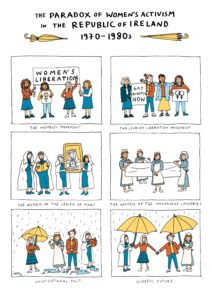
What is the paradox of women’s activism? The accepted history of women in the Republic of Ireland has been one of progression since the 1960s. But this considers only one group of women, the women’s movement, because of their success of moving into politics.  It does not consider the rural-urban divide, traditional gender roles or the subversion of other groups.  

To understand more about the activism happening during this period, this thesis will focus on four groups of women.  


It seeks to understand if the women’s movement, in a bid to be deemed successful, unintentionally excluded other groups of women from the historical narrative and to bring all four groups under the same umbrella term of ‘women’s activist’. 


Better? I think so. 

Speaking across the academic divide

One might argue that the same level of detail is not given in the second option compared to the first. This is the point; Option 1 provides no space for natural interest or for your audience to want to ask questions. Option 2 on the other hand, is eye capturing and the audience are likely going to want to know more about how I think I can bring the women mentioned under one umbrella.   

Illustrations are a useful tool that have better enabled me to communicate my work. They speak across the academic divide and create opportunities to start a dialog on your work that is interesting to all parties and not just to people who feel the same passion as you.  

Commissioning the artwork 

Finding an artist whose work I liked was the hardest part of the process. I found Lesley Imgart through the Wellcome Collection. It was her ability to add emotion into her art that enticed me. I reached out via email and briefly told her my idea. We agreed on the commission price and the expected outcomes. The process was fascinating to a non-artist like myself: the work she put into understanding the clothing and colours of the period was unexpected but very beneficial. She also provided me with two colour options, as seen below. If you would like to know more about Lesley, you can find her website here. Alternatively, she has a specific blog about the creation of my artwork here 


Written by Sarah Golding, PhD Student in the History at Birkbeck, University of London.
Twitter: @sarahgolding923 

Illustrations done by Lesley Imgart
Twitter: @imgart, Instagram: @lesleyimgart
 

Further information:  


Forecasting the Trajectory of an Epidemic

Mark Levene is Professor of Computer Science in Birkbeck’s Department of Computer Science and Information Systems. He shares insights from research into modelling the waves of an epidemic.

Epidemics such as COVID-19 come in “waves”, although the precise definition of a wave in this context is somewhat elusive.  A standard way to model the epidemic is as a time series that records, say the number of daily hospitalisation or deaths, and these can be plotted to view the progress of the epidemic.

Waves in the time series span from one valley to another with a peak in between them. The shape of an individual wave can be modelled as a statistical distribution and several waves can be sequentially combined. More often than not waves are not symmetric, that is, the rate at which, say hospitalisations, increase is not the same rate at which they decrease once the peak of the wave has been reached. This non-symmetrical nature of a wave is called its skewness.

To take into account the skewness of epidemic waves we introduce the skew logistic distribution, which is a novel yet simple extension of the symmetric logistic distribution widely used in the modelling of epidemic data.

To validate our model, we provide a full analysis of the first four waves of COVID-19 deaths in the UK from the 30 January 2020 to 30 July 2021.

Our results show a good fit to the proposed skew logistic distribution, and thus could potentially augment existing more established models that are being used to forecast the trajectory of an epidemic.

Our findings have been published in MDPI Entropy.

Further Information

Ageing Populations and Macroeconomy

Yunus Aksoy smiling into the camera.Professor Yunus Aksoy shares how ageing populations impact the workforce and discusses possible policy responses.

Ageing populations are a global phenomenon. They are caused by two main trends:

  1. Fertility decline: the number of children per woman in a population has been slowly decreasing since the 1990s.
  2. Declining mortality rates: people are living longer due to medical advances and lifestyle changes.

These demographic structure changes have wide-reaching impacts in the short and medium/long term. However, the fact that their impact is not visible day-to-day means that they are relatively less discussed in everyday policymaking. My work with my colleagues Professor Ron Smith at Birkbeck, Dr Henrique Basso at the Bank of Spain and Dr Toby Grasl investigates the impact of ageing populations on macroeconomy in general and brings it to the table in policy circles. I am very pleased to see that the issue has started to be taken seriously by many international organisations like the IMF, ECB, World Bank, BIS and numerous central banks. Our research has had significant impact on the debate.

Economists tend to concentrate on growth, inflation and unemployment rates, and what Central Banks and Finance Ministries can do to stabilise the economy over the short term. However, there are other deep and slowly changing forces affecting the economy about which policymakers can do little. The weak recovery after the global financial crisis has sparked renewed interest in these longer term forces, including demographics, which had often been ignored. As individuals, we are often aware of the adverse effects of ageing, as the years go by. Societies can suffer similar adverse effects from ageing, and most developed economies are ageing.

According to the UN Population Division, almost every developed economy has seen a decline in fertility rates and an increase in life expectancy. As a result, the average proportion of the population aged 60+ is projected to increase from 16% in 1970 to 29% in 2030, with most of the corresponding decline experienced in the 0-19 age group in 21 OECD economies.

In the 1960s, Simon Kuznets suggested that a society consisting of consumers, savers and producers can grow in a sustainable way if the demographic structure was a rough pyramid. Larger at the bottom, where there are the youngest – up to the age of twenty or so – the working age next – then at the top a smaller group of older people. The pyramid is now turning upside down, with the bulge at the top.

Why is the demographic structure relevant?

Our research has examined the impact of demographic structure on economic activity, productivity, and innovation. Demographic structure may affect long and short-term economic conditions in several ways. Different age groups have different savings behaviour; have different productivity levels; work different amounts (as the very young and very old tend not to work); contribute differently to the innovation process; and have different needs. Therefore, changes to the demographic structure of a society can be expected to influence interest rates and output in both the long and short-term.

Our analysis shows that the changing age profile across OECD countries has economically and statistically significant impacts and that it roughly follows a life-cycle pattern; that is, people who are likely to be dependent on state or other forms of support – generally the very young and the old populations – seem to reduce economic growth, investment and real returns in the long-run.

Demographic structure also affects innovation; the economy is less likely to develop and/or patent new innovations/inventions. Similarly, productivity, which is driven by innovation, is positively affected by young and middle aged cohorts and negatively by the dependant young and retirees.

Demographics, innovation and medium-run economic performance

When people expect to live longer, they save more for their retirement and consume less, increasing demand for investment products and causing a decline in their returns. This provides one explanation in the steady decline in real interest rates in OECD countries since the 1980s. But it leaves us with a puzzle. A decrease in long-term interest rates should increase investment, but that is not what we observe. Our estimates show that long-term investment is declining. Our solution to the puzzle is that aging has also lowered the productivity of investment, reducing the incentive to invest, because the rate of ideas production and innovation, mainly done by the young, has reduced.

With fewer younger people in the population, there will be less creativity and ideas. Thus, while the cost of investment finance may be lower due to higher savings of the aging population, there are not enough ideas worth capitalising on and so long-term investment and real output declines. An ageing population also throws up social challenges, such as the provision of care for the elderly and how this can be supported.

Are there solutions?

While immigration may address the shortage of workers in the middle of the age categories, the political problems it raises are such that governments are usually unwilling to develop immigration policies that would truly address the issue. Furthermore, as populations are aging globally, this is not an adequate long-term solution. Giving more childcare support for young parents could help increase fertility rates and this is also related to building human capital starting from a very young age.

Increases in productivity by investing in human capital, education and skills is of crucial importance, as is increased funding for research and development that could bolster a  generation of new ideas and create new innovations and investment opportunities.  At Birkbeck, we have long understood the importance of lifelong learning that is directly associated with productivity gains for the economy, which in the current climate could help to compensate for a reduced workforce and staggered productivity. Robots and AI could also address the productivity/labour supply challenges, especially if we reach a point where machines can generate innovations and robots might be used more to fill gaps in the work force and provide care for the elderly, but it might make more people unemployed.

A typical challenge is that politicians are often short sighted. Long-term investment in order to boost human capital and productivity would not be a top priority for an incumbent politician in the short term, despite the transformative effects they could have for the generations to come.  Often, what we think is happening now is the slow moving changes that started a long time back, so a long-term view is essential to tackle the economic impact of ageing populations to address the future.

Further Information

Further Reading