Discover our Research: Meet the academics

As part of Birkbeck’s Discover our research activity, Professor Anthony Bale of the Department of English and Humanities writes about his current research activity.

Prof Anthony Bale

Prof Anthony Bale

What is your current topic of research?

Holy mountains and emotions in the medieval Holy Land.

What inspired you to research this?

I realised that, in their accounts of their travels in the Holy Land, medieval pilgrims often described feeling strong emotions on top of mountains. This led me to think about the relationship between emotions and landscape. This helps me retrieve a sense of how people felt during their pilgrimages, rather than focussing simply on what they did. It also helps me revise the dominant – and incorrect – modern understanding that people in the Middle Ages had no or little appreciation of the landscape.

What excited you about this area of investgation?

I’m very excited about this topic – it is completely unexplored in previous scholarship, and it allows me to revise lots of misunderstandings about the Middle Ages. Essentially, I am able to show how several things which are thought of as quintessentially ‘modern’ – such as the vista, the appreciation of the landscape, the cultivation of specific emotions – were features of the medieval journey to Jerusalem.

What’s challenging about this topic?

The research is challenging on several levels. The historian of emotions is working with partial sources that describe feelings in terms very different from today’s. It’s important not to read our own emotional vocabulary back into the medieval sources: for instance, many sources say that pilgrims felt “joy” at the top of a mountain, but this is not the same as “happiness” or “the sublime”. Rather, medieval “joy” has a complex and clear theological and philosophical set of associations. This work is also beset with difficulties due to the partial nature of the sources I’m working with and the present-day politics of the sites I’m working on.

Nabi Samwil (Palestine), known in the Middle Ages as 'Mount Joy', a hill from which pilgrims took their first view of Jerusalem (Pic courtesy of Prof Bale)

Nabi Samwil (Palestine), known in the Middle Ages as ‘Mount Joy’, a hill from which pilgrims took their first view of Jerusalem (Pic courtesy of Prof Bale)

What are the potential impacts of your research on everyday life?

My work is part of an attempt to write a richer and deeper history of the western engagement with the Holy Land in the Middle Ages. This engagement has a very long afterlife, and has coloured not only the ways in which Christians continue to engage with holy space, but also the present-day terrain of the conflict between Israel and Palestine.

What are your main goals in work?

My main goals in my work are to continue to challenge myself, extending my work in new directions, and to continue to uncover new and interesting aspects of medieval culture. Even though I’ve been studying my sources for many years, the Middle Ages definitely continue to surprise me and to engage my intellectual curiosity.

What kind of a research environment is Birkbeck to work in?

Birkbeck is a great research environment for several reasons. Researchers are able to follow the topics and sources that interest them, it’s a very accommodating and open-minded research environment. Because there is such a lively research student community too, there is always an atmosphere of exciting research being undertaken.

For a medievalist, Birkbeck has a fantastic community of people working in the premodern period, and of course we are very close to some of the best resources in the world for medieval studies: the British Library, the British Museum, the National Archives, and so on.

Find out more

Improving attentional control to reduce anxiety

This post was contributed by Prof Nazanin Derakhshan of Birkbeck’s Department of Psychological Sciences. Here, Prof Derakhshan describes her most recent study into how our cognitive flexibility can be trained and boosted to protect against the effects of anxiety

Anxiety-webAnxiety can be a debilitative emotion that can adversely affect our performance. For example, it is common for individuals with high levels of anxiety to worry excessively about a variety of issues ranging from their performance on upcoming examinations, job interviews, attending meetings, and giving talks to multi-tasking and managing everyday activities efficiently.
According to the WHO (World Health Organisation) anxiety (and depression) will be the biggest cause of disability worldwide by 2025. People with high anxiety frequently report that they have difficulty concentrating on tasks that need undivided attention and are easily distracted. It goes without saying that the implications of anxiety’s effects on our everyday activities as well as on the challenging tasks demanding our attention are vast.

Unfortunately, anxious individuals remain at a disadvantage of getting stuck in a viral chain of worries and over-thinking, consequently needing to invest more effort as compensation to their worries in getting tasks done (see Berggren & Derakshan, 2013, for a review).

How can we explain the nature of the relationship between anxiety and performance?

In a theoretical breakthrough, we have proposed earlier (see Eysenck, Derakshan, Santos & Calvo, 2007; Derakshan & Eysenck, 2009) that a central mechanism by which anxiety impairs performance is via its adverse effects on attentional control. Attentional control is an important function of our working memory, a system that regulates incoming information and helps with temporary storage of information.

Attentional control or cognitive flexibility directs our attention towards what is relevant and away from what is irrelevant. Attentional control is thus a vital ingredient of our lives, it helps us be cognitively flexible, concentrate on tasks and resist distracting thoughts/information when we need to. When we have poor attentional control we become inefficient and can do badly in tasks; we can’t keep worries at bay, and get trapped in cycles of over-thinking that can hold us back from performing well. There is now substantial evidence to support the prediction that anxiety impairs performance via its impact on attentional control (see Berggren et al., 2013).

How can we reduce the effects of anxiety on performance?

If attentional control is a causal mechanism that can explain anxiety’s effects on performance then it can be trained and boosted to protect against the effects of anxiety on performance. In the current study, which will be published in the journal Biological Psychology, we asked participants with a high anxiety disposition to train on an adaptive cognitive task for a period of 15 days over three weeks, for half an hour every day, and all training was performed online.

The special thing about the training protocol is the adaptive nature of the task that increases and decreases in difficulty based on participant performance levels. Elsewhere, we have shown that training on this task improves attentional control in subclinical depression (see Owens, Koster & Derakshan, 2013; see also our BBCR4 programme on How to Have a Better Brain.

In the current study, we assessed participants’ levels of attentional control using a number of tasks measuring distractibility (e.g. a flanker task that was performed under stressful and non-stressful conditions), an antisaccade task measuring inhibition of threatening faces and resting state attentional control using electrophysiological measures. Participants completed these tasks before and after the intervention. We also had a control group who performed a non-adaptive version of the training.

Did training improve attentional control?

Graph from Prof Derakhshan's current study showing changes in anxiety as a function of engagement with training

Graph from Prof Derakhshan’s current study showing changes in anxiety as a function of engagement with training

Our results showed that those undergoing adaptive training compared with the control group showed greater transferability of training related gains onto attentional control measures. Specifically, they were better at inhibiting distractors in the flanker task, and this superiority was especially apparent when stressed, i.e. they could exercise attentional control much better than the control group when they were under stress.

The training group also had better resting state attentional control compared with the control group. Importantly, engagement with training as shown by improvement on the training task, from first to last day of training, correlated with reductions in anxiety levels after the intervention relative to before the intervention. This meant that those who improved more on the training task had lower levels of anxiety vulnerability after training.

Why are the results of the current study important?

The most important message here is that attentional control can be trained with transferrable effects on unrelated tasks measuring relevant cognitive functions such as distractibility, inhibition, and concentration in individuals suffering from high levels of anxiety. Furthermore, our findings showed that improving attentional control can reduce anxiety in individuals with an anxious predisposition.

They also attest to the causal mechanism of attentional control protecting against anxiety vulnerability especially under stress. The implications of improving attentional control are enormous in education and clinical science. Targeting and training working memory using adaptive tasks that exercise attentional control holds the potential to protect against longer term under-achievement in anxious pupils. It can also protect against the development of clinical anxiety which can be debilitative to the individual.

How can the current study be extended?

There are a few ways in which future research can build upon the current findings. First, if attentional control training shows promise to increase processing efficiency then it can be used as an adjunct to traditional therapies such as mindfulness and CBT that rely on pre-frontal functions such as concentration and attention focus.

Second, it is essential to examine the sustainability of the effects of adaptive cognitive training on performance and anxiety vulnerability and get an indication of how training effects consolidate with the environment over time. How are behaviours changed? Finally, it seems essential from a clinical point of view to look at how training can impact on a person’s quality of life and levels of resilience throughout time.

Find out more

Adolescents and multitasking

This post was contributed by Dr Iroise Dumontheil of Birkbeck’s Department of Psychological Sciences, and co-author of the newly published study “Multitasking during social interaction in adolescence and early adulthood”. The paper, published in Royal Society Open Science, can be read hereClick here to read the news article

Presentation of multitasking paradigm (published in Royal Society Open Science)

Presentation of multitasking paradigm (published in Royal Society Open Science) * Caption below

Humans are social beings. We have evolved to function in groups of various size. Some researchers argue that the complexity of social relationships which require, for example, remembering who tends to be aggressive, who has been nice to us in the past, or who always shares her food, may have been an evolutionary pressure leading to the selection of humans with bigger brains, and in particular a bigger frontal cortex (see research by Robin Dunbar).

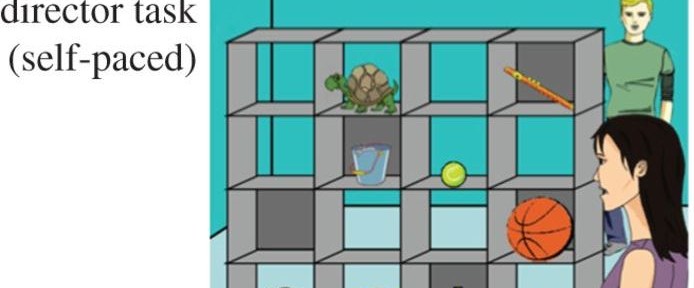
However, we do not always take into account the perspective or knowledge of a person we are interacting with. Boaz Keysar and later Ian Apperly developed an experimental psychology paradigm which allows us to investigate people’s tendency to take into account the perspective of another  person (referred to as the “director”) when they are following his instructions to move objects on a set of shelves. Some of the slots on the shelves have a back panel, which prevent the director, who is standing on the other side of the shelves, from seeing, and knowing, which objects are located in the slots. While all participants can correctly say, when queried, which object the director can or cannot see, adult participants, approximately 40% of the time, do not take into account the view of the director when following his instructions.

In a previous study, Sarah-Jayne Blakemore (UCL), Ian Apperly (University of Birmingham) and I, demonstrated that adolescents made more errors than adults on the task, showing a greater bias towards their own perspective.  In contrast,  adolescents performed to the same level a task matched in terms of general demands but which required following a rule to move only certain objects, and did not have a social context (read the study here).

The Royal Society Open Science journal is publishing today a further study on this topic, led by Kathryn Mills (now at the NIMH in Bethesda) while she was doing her PhD with Sarah-Jayne Blakemore at UCL. Here, we were interested in whether loading participants’ working memory, a mental workspace which enables us to maintain and manipulate information over a few seconds, would affect their ability to take another person’s perspective into account. In addition, we wanted to investigate whether adolescents and adults may differ on this task.

What would this correspond to in real life? Anna is seating in class trying to remember what the teacher said about tonight’s homework. At the same time her friend Sophie is talking to her about a common friend, Dana, who has a secret only Anna knows. In this situation, akin to multitasking,  Anna may forget the homework instruction or spill out Dana’s secret, because her working memory system has been overloaded.

Thirty-three female adolescents (11-17 years old) and 28 female adults (22-30 years old) took part in a variant of the Director task. Between each instruction given by the director, either one or three double-digits numbers were presented to the participants and they were asked to remember them.

Overall, adolescents were less accurate than adults on the number task and the Director task (combined, in a single “multitasking” measure) when they had to remember three numbers compared to one number. In addition, all participants were found to be slower to respond when the perspective of the director differed from their own and when their working memory was loaded with three numbers compared to one number, suggesting that multitasking may impact our social interactions.

Find out more

*Image caption: Presentation of multitasking paradigm (image published in Royal Society Open Science paper). For each trial, participants were first presented with either (a) one two-digit number (low load) or (b) three two-digit numbers (high load) for 3 s. Then participants were presented with the Director Task stimuli, which included a social (c) and non-social control condition (d). In this example, participants hear the instruction: ‘Move the large ball up’ in either a male or a female voice. If the voice is female, the correct object to move is the basketball, because in the DP condition the female director is standing in front of the shelves and can see all the objects, and in the DA condition, the absence of a red X on the grey box below the ‘F’ indicate that all objects can be moved by the participant. If the voice is male, the correct object to move is the football, because in the DP condition the male director is standing behind the shelves and therefore cannot see the larger basketball in the covered slot, and in the DA condition the red X over the grey box below the ‘M’ indicates that no objects in front of a grey background can be moved. After selecting an object in the Director Task, participants were presented with a display of two numbers, one of which corresponding to the only number (e) or one of the three numbers (f), shown to them at the beginning of the trial. Participants were instructed to click on the number they remembered being shown at the beginning of the trial.

Structured Mayhem: Personal experiences of the Crown Court

This post was contributed by researchers Jessica Jacobson, Gillian Hunter and Amy Kirby from the Institute for Criminal Policy Research (ICPR), School of Law at Birkbeck discuss a recent collaboration with the Criminal Justice Alliance an organisation which works in partnership with 90 member organisations to promote better outcomes across the criminal justice pathway.

Structured-Mayhem-webStructured mayhem: Personal experiences of the Crown Court, is a digest of our research into what it is like to attend Crown Court as a victim, witness or defendant published in full earlier this year as Inside Crown Court (Policy Press).

The Digest describes the elaborate, ritualised and in many respects archaic nature of proceedings in the Crown Court, highlighting how these proceedings can be bewildering and alienating for victims, witnesses and defendants alike. The title of the Digest, Structured Mayhem, conveys the often chaotic nature of the criminal trial and other court hearings, and the inherent challenges involved in seeing a case through to completion. Trials often have a large cast of characters, which must be brought together along with vast documentation and a range of evidence in various forms including video or audio recordings and physical artefacts. Things often go wrong, and delays and adjournments are commonplace.

Participating in the court process

Court proceedings are highly theatrical; but these are dramas within which the legal professionals – particularly the prosecution and defence counsel – playing the starring roles, while the victims, witnesses and defendants having only minor parts. And if victims and witnesses occupy a walk-on role in proceedings, defendants could be said to take on the part of ‘ever-present extras’. Rather than being the focus of events, they often appear to be the least important characters at court: almost incidental to the proceedings that, in fact, largely revolve around them. One manifestation of this paradoxically central but marginal status in court is a marked passivity on the part of many defendants towards being in court. This passivity, which was frequently expressed in our research interviews, runs counter to the widely established principle in law that, in order to exercise fully their right to a fair trial, defendants should be able to participate effectively in the court process.

We have blogged previously about the often stressful and disaffecting experiences of Crown Court reported by victims and witnesses and also about the range of initiatives that have been introduced over recent years to help them at court. Examples include the introduction of the Witness Service, whose volunteers provide support to those giving evidence, and the ‘special measures’ made available for vulnerable or intimidated witnesses, including being permitted to give evidence from behind a screen or via a videolink. Provision for vulnerable defendants is less extensive than that for vulnerable witnesses, but it is increasingly accepted that their ‘effective participation’ in the court process often depends on adequate support and practical adaptations.

What needs to be done to improve participation?

Structured Mayhem includes a series of recommendations from the Criminal Justice Alliance for the Ministry of Justice, HM Courts and Tribunals Service and other agencies, which are aimed at improving the experience of all court users and enhancing the public’s confidence in the criminal justice system.

The recommendations include ensuring equivalence of provision of ‘special measures’ across all groups of court users; promoting the use of ‘plain English’ by professionals at court, and explanation of technical terms, to aid victims’, witnesses’ and defendants’ understanding of what is going on; greater use of restorative justice approaches to further offenders’ opportunities to take responsibility for their offending behaviour and to engage with the court process; and use of the dock during court hearings – which isolates defendants and further alienates them from proceedings – on a discretionary basis only, where the judge deems it necessary for reasons of safety.

Find out more